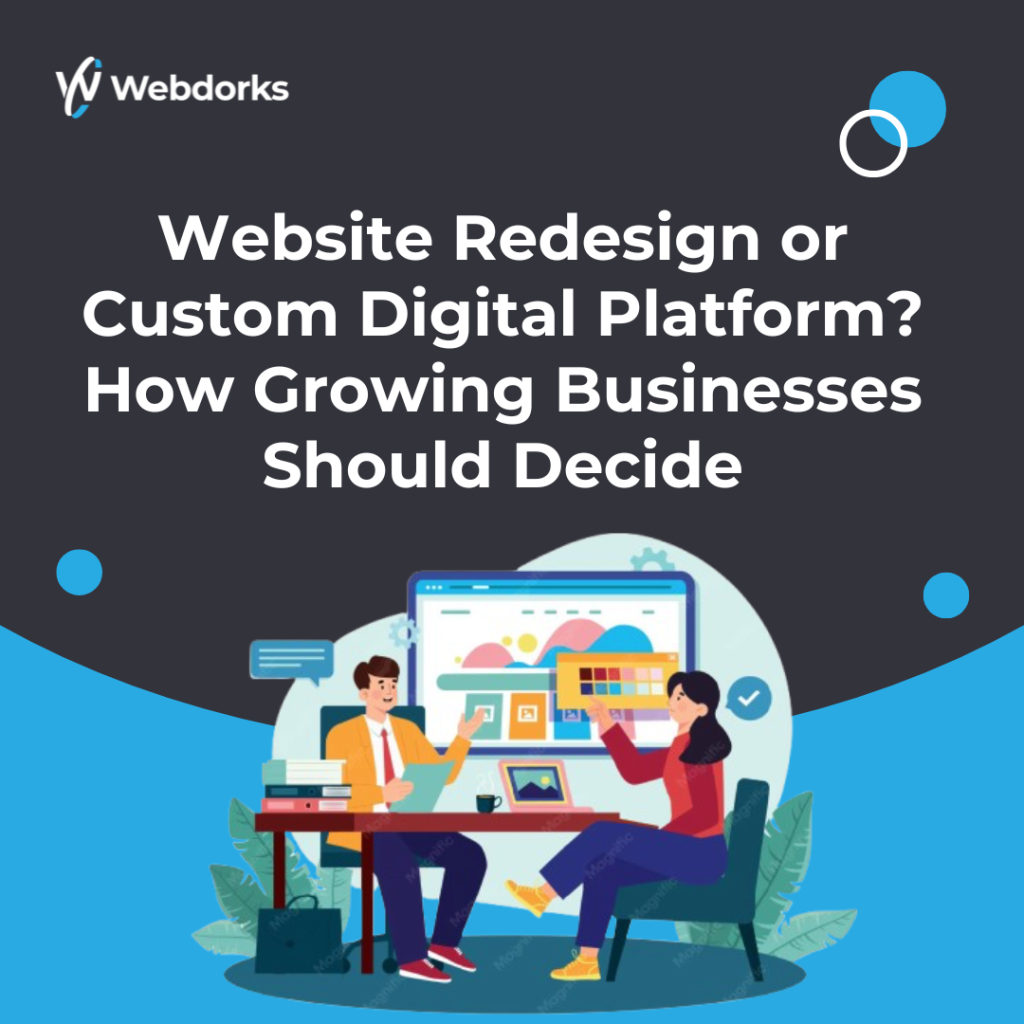
Website Redesign or Custom Digital Platform? How Growing Businesses Should Decide
When a company reviews its digital presence, it is easy to assume that the solution is simply a more modern website.
Sometimes that is correct. A refreshed website can improve credibility, make services easier to understand, and create a smoother path for enquiries.
However, other businesses have reached a point where the problem is not only visual. Their customers or staff need to complete real workflows online.
Start with the Purpose
A corporate website is usually appropriate when the business primarily needs to:
- communicate its brand and services;
- publish content and updates;
- generate leads;
- showcase projects or case studies;
- support recruitment;
- provide contact forms, downloads, or basic booking functions.
A custom platform or web app becomes more relevant when users need to:
- log in;
- submit information;
- upload documents;
- track progress;
- generate quotations;
- review reports;
- manage approvals;
- interact with operational data.
The difference matters because the planning process changes significantly.
A website project focuses on content architecture, page design, usability, mobile responsiveness, and conversion paths.
A web-app project also requires workflow mapping, user permissions, database planning, integrations, testing, security controls, and ongoing enhancement.
The Middle Ground: A Website with Functional Layers
Not every project fits neatly into one category.
A business may require a corporate website with selected application features, such as:
- a dealer login area;
- a customer dashboard;
- a resource library;
- an appointment system;
- a quotation request portal;
- a members-only section;
- a secure document-upload feature.
This approach allows the public website and the operational system to work together without overcomplicating the first release.
How AI-Assisted Prototyping Helps
AI can speed up early-stage exploration by helping teams visualise alternative layouts and workflows.
Before a business commits to a full build, decision-makers can review:
- how the homepage communicates the company’s value;
- how visitors move through the website;
- what happens after a customer submits a form;
- whether a dashboard is actually useful;
- how a portal should be structured;
- which features belong in the first release.
AI should not replace structured planning. It should make the planning process more efficient.
The right question is not whether the business needs the newest technology. It is whether the solution addresses a real business problem in a practical and maintainable way.
FAQs
Should a growing business redesign its website or build a custom platform?
The answer depends on the main business problem. A website redesign may be enough if the objective is to improve branding, content, enquiries, and usability. A custom platform may be needed when customers or staff need to complete workflows, access dashboards, upload documents, or manage data online.
Can a corporate website include app-like features?
Yes. A corporate website can include selected functional features such as customer login areas, appointment forms, secure resource libraries, quotation-request tools, and members-only sections. This may be suitable when the business needs additional functionality without building a full custom system immediately.
What should a business prepare before starting a digital project?
The business should clarify its objectives, target users, content requirements, required features, existing systems, and budget range. For web apps, it is also important to map the workflow, user roles, data requirements, and possible integrations.
Is a custom digital platform more expensive than a website?
Usually, yes. A custom platform requires additional planning, workflow design, database development, user-permission controls, testing, and ongoing improvement. However, the investment may be worthwhile when the system reduces manual work or improves customer experience significantly.
How can AI-assisted prototyping support stakeholder alignment?
AI-assisted prototyping can help stakeholders visualise early concepts before full development begins. This makes it easier to compare possible layouts, review workflows, identify missing requirements, and align decision-makers earlier in the process.
Related services:
Media coverage:
Webdorks’ AI-assisted prototyping announcement was carried by Australian publications including The Times Australia and The Business Times Australia.
Next steps & downloadable checklists
APAC launch in 90 days?
Unsure about SG hosting, PDPA, or timelines? Book your 20-min review with us.